Suction
1,200 Pa
Battery
110 min
Navigation
Spinning Lidar
Mopping
1 Fixed Pad
Full Specifications
| Suction Power | 1,200 Pa |
| Battery Life | 110 min |
| Dustbin Capacity | 430 ml |
| Navigation | Spinning Lidar |
| Robot Height | 3.66" |
| Threshold Climbing | 20 mm |
| Brush Roll | Single |
| Mopping | 1 Fixed Pad |
| Self-Empty Dock | No |
| Obstacle Avoidance | No |
| Multi-Floor Maps | Yes |
| No-Go Zones | Yes |
| Carpet Boost | Yes |
| HEPA Filter | Yes |
| WiFi | 2.4 GHz |
| Voice Assistants | Alexa, Google |
| Warranty | 1 year |
Compare with similar models:
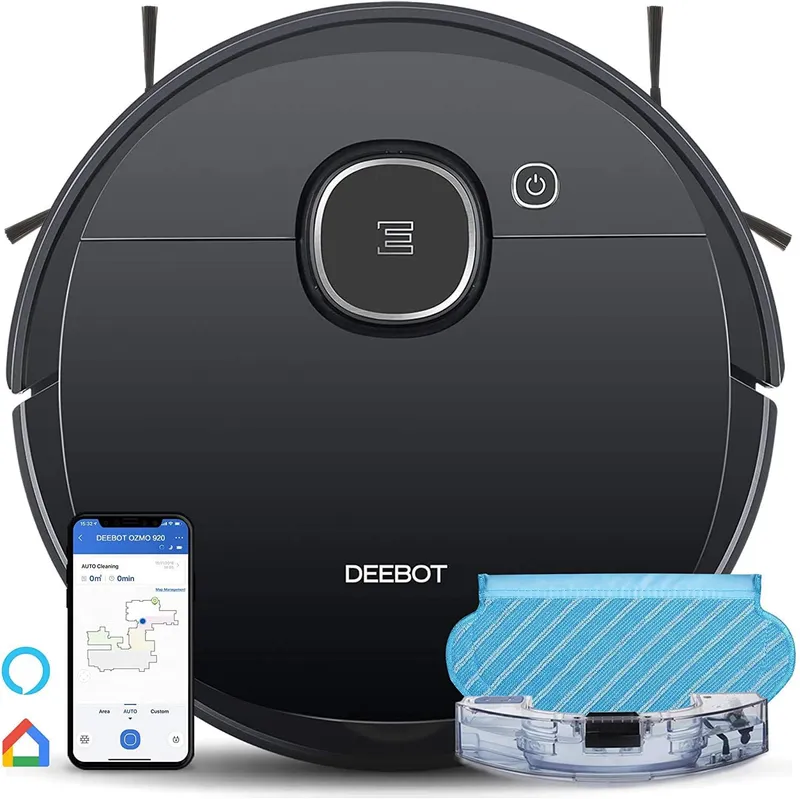
The Ecovacs Deebot 920 was a solid mid-range contender when it launched in August 2019, retailing at around $699. Six years later, it’s been discontinued and largely forgotten, replaced by the N8, T8, and T9 series. You’ll occasionally spot one on eBay or Amazon as old stock, but here’s the thing: paying $400+ for this robot makes no sense when a brand-new $300 vacuum will run circles around it.
The Good News: Premium Build, Quiet Operation
At 3.66 inches tall, the 920 sits slightly lower than most LiDAR-equipped robots (which typically hit 3.8 inches), giving it a better shot at slipping under couches and bed frames. The matte black finish with gloss accents still looks classy, and at 7.9 lbs it feels substantial without being awkward to carry upstairs.
The noise levels deserve mention. At 66 dB, it’s noticeably quieter than the high-suction monsters flooding the market now. If you’re working from home while the robot cleans, you’ll appreciate the difference.
Navigation: Smart Navi 3.0
The robot uses LDS LiDAR (Ecovacs called it “Smart Navi 3.0”) to map your home in real-time. It navigates in methodical serpentine patterns and rarely misses spots. Dark rooms? No problem. LiDAR sees without light.
But there’s a catch. Floor-to-ceiling mirrors will confuse the sensors, creating “phantom rooms” on your map. And speaking of maps, the 920 has a notorious reputation for map corruption. The map might randomly rotate 45 degrees, or simply overwrite itself if you nudge the charging base. When this happens, you’re starting over with a full remap. It’s frustrating enough that Reddit threads are filled with complaints about it.
Cleaning Power: Dated by 2025 Standards
Here’s where the 920 shows its age. The 1,200 Pa suction was respectable in 2019, but budget robots now deliver 4,000+ Pa. On hard floors, the dual side brushes (green and red, helpfully color-coded) sweep debris into the robot’s path effectively. It handles dust, crumbs, and hair without drama.
Carpet is a different story. The suction simply can’t pull fine particles from medium-pile carpet fibers the way modern robots can. It’ll grab surface debris just fine, but don’t expect deep cleaning.
Pet owners face a maintenance trade-off. The 920 picks up animal hair well enough, but without anti-tangle technology, long hair wraps tightly around the main brush and side brush axles. Plan on cutting it free weekly, or you’ll burn out those side brush motors.
The 430ml dustbin is average, and the high-efficiency filter (sponge plus pleated paper) does its job. You can wash the sponge; just tap out the pleated filter or replace it periodically.
Mopping: Functional, Not Impressive
The “Ozmo” mopping system was ahead of its time in one respect: the robot automatically avoids carpet when the mop pad is attached. That’s genuinely useful. But the mopping itself is just a damp cloth dragging passively across your floors. It picks up surface dust nicely. Dried-on stains? Forget it. This isn’t the vibrating, scrubbing action you’ll find on newer Ozmo Pro models.
The 240ml water tank offers four flow levels adjustable through the app: low, medium, high, and ultra high. The no-mop zones feature lets you keep the robot away from rugs while cleaning.
Battery and Coverage
The 3,200 mAh battery runs about 110 minutes on standard power. That covers roughly 1,600 square feet before the robot needs to return and recharge. If your home is larger, expect a mid-cleaning break. Worth noting: the nearly identical Deebot 950 shipped with a 5,200 mAh battery. The 920 is essentially the “lite” version.
The recharge-and-resume feature works as expected. The robot returns to finish the job after topping up.
The App Experience
The Ecovacs Home app handles the basics: multi-floor mapping (two permanent maps), virtual boundaries, no-go lines, and room labeling. Voice control works through Alexa and Google Assistant. You can watch the cleaning path in real-time.
That said, the app feels cluttered compared to Roborock’s cleaner interface. The room labeling auto-segmentation is widely reported as “finicky.” And remember that map loss issue? The app offers no protection against it. One wrong move of the charging dock and your carefully labeled rooms vanish.
The app sits at about 3.4 stars in app stores, which tells you something.
What Will Break
If you’re buying a used 920, know the common failure points:
LiDAR turret failure ranks highest. The motor belt inside the spinning laser tower tends to slip or snap after two to three years, triggering “LDS Malfunction” errors. Handy users can replace the belt themselves; everyone else faces an expensive repair.
Battery degradation becomes noticeable after about two years. Replacement batteries run $30-$40 and are easy to find.
Side brush motors die if hair builds up around the axles. Regular cleaning prevents this.
On the bright side, generic filter and brush kits cost just $15-$25 on Amazon. And since there’s no self-empty station, you won’t pay for replacement bags.
Known Limitations
A few gotchas worth flagging:
- Black carpets trigger false cliff warnings. The IR cliff sensors interpret dark patterns as stairs. Some users tape over the sensors, which works until the robot tumbles down actual stairs.
- 2.4GHz Wi-Fi only. If your router broadcasts a combined network, you may need to separate the bands during setup.
- No self-empty upgrade path. Unlike the N8 and T8 series, you can’t add an auto-empty station later.
- No object recognition. The robot will plow straight through cables, socks, and anything else in its path. Pet waste included.
Should You Buy One?
At $100-$200 on the used market, the Deebot 920 offers solid hard-floor cleaning and quiet operation. The build quality still feels premium, and replacement parts are cheap and available.
But honestly? A refurbished Roborock Q5 or Dreame D10 at the same price will outperform it significantly. You’ll get triple the suction power, better battery life, and an app that won’t randomly erase your floor plan.
The 920 made sense in 2019. In 2025, it’s a nostalgia purchase at best.