Suction
7,000 Pa
Battery
260 min
Navigation
Spinning Lidar
Mopping
1 Vibrating Pad
Full Specifications
| Suction Power | 7,000 Pa |
| Battery Life | 260 min |
| Dustbin Capacity | 350 ml |
| Navigation | Spinning Lidar |
| Robot Height | 3.83" |
| Threshold Climbing | 20 mm |
| Brush Roll | Single |
| Mopping | 1 Vibrating Pad |
| Mop Raising Height | 7 mm |
| Self-Empty Dock | No |
| Obstacle Avoidance | Yes |
| Multi-Floor Maps | Yes |
| No-Go Zones | Yes |
| Carpet Boost | Yes |
| HEPA Filter | Yes |
| WiFi | 2.4 GHz |
| Voice Assistants | Alexa |
| Warranty | 2 years |
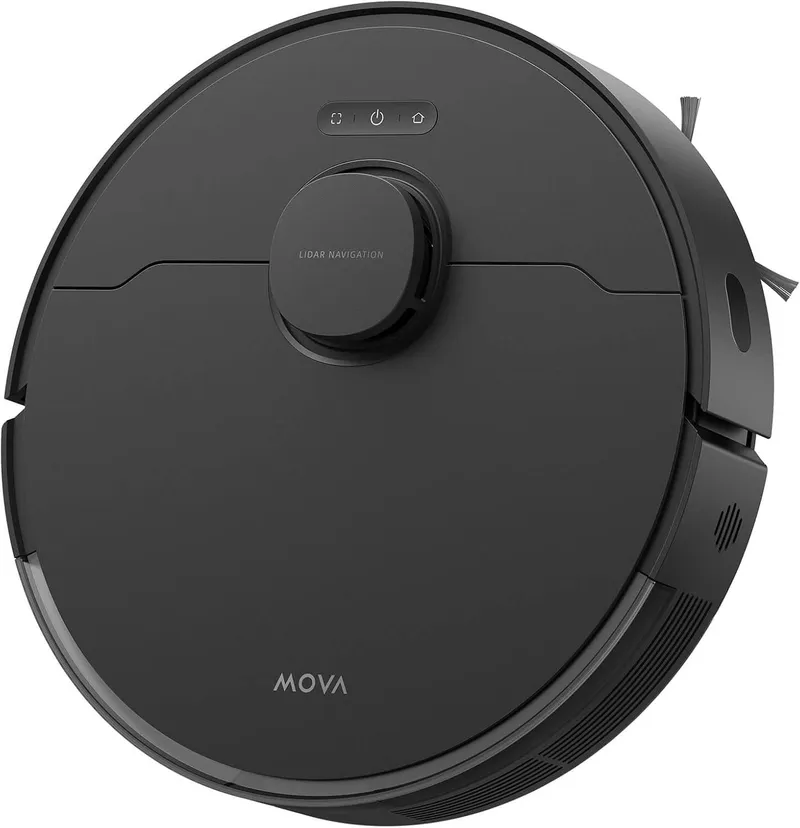
Compare with similar models:
Mova S10 Robot Vacuum: A Budget Powerhouse That Punches Above Its Weight
The Mova S10 shouldn’t exist at this price point. At roughly $169 on sale (sometimes dipping as low as $109 during promotions), it delivers LiDAR navigation, vibrating mop technology, and 7,000 Pa suction that rivals robots costing three to four times as much. Launched in June 2024 as part of Dreame Technology’s sub-brand expansion, the S10 has quickly become one of the most compelling budget robot vacuums available.
What You’re Getting
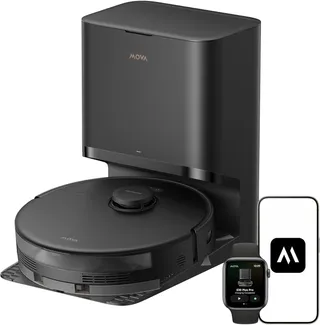
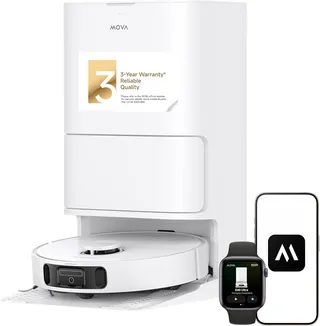
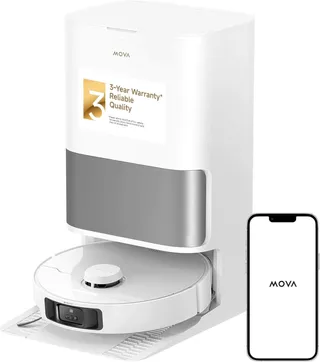
The S10 measures 350 x 350 x 97.4 mm (about 13.8 x 13.8 x 3.8 inches) and weighs 3.9 kg (8.6 lbs). That 97mm height lets it slip under most furniture with at least 4 inches of clearance. It comes in matte black, with a white variant apparently available in some European markets.
Two package options exist: the standard S10 with a basic charging dock, and the S10 Plus that bundles the same robot with a self-emptying dock. The robot itself is identical in both packages.
You can find it on Amazon (sold through MOVA’s official store), Walmart, and Mova’s own website. It’s available in over 30 countries as of 2025.
Hardware That Surprises
Suction and Cleaning Power
The headline spec is 7,000 Pa maximum suction, marketed under Mova’s “Vormax” branding. While manufacturer suction claims should always be taken with a grain of salt, independent testing backs this one up. Vacuum Wars measured a 90% deep-clean score on carpet, meaning it pulls embedded dirt from carpet fibers at rates matching or beating robots that cost $500 or more. The average robot manages about 77%.
The Brush System
A single all-rubber main roller does the heavy lifting. This floating brush maintains contact across uneven surfaces and resists tangling remarkably well. In hair pickup tests, only about 28% of long hair tangled on the S10’s brush compared to nearly 97% on a Roomba 600’s bristle brush. A three-arm side brush handles edge sweeping.
The dustbin holds around 470 mL (some specs list 350 mL, but the larger figure appears accurate based on third-party testing). A HEPA-type filter traps fine dust and allergens.
Battery Life
A 5,200 mAh battery delivers up to 260 minutes of runtime on quiet mode, covering roughly 175 square meters (about 1,880 sq ft) per charge. Even at higher power settings with mixed vacuuming and mopping, expect around 180 minutes. Vacuum Wars gave it a perfect 5/5 for battery performance.
If it runs low mid-clean, the S10 returns to dock, recharges, and picks up where it left off. Full charging takes about 4 hours.
Sensors
The spinning LiDAR turret on top maps your home in 360 degrees, enabling efficient row-by-row cleaning rather than random bouncing. Front-facing 3D structured-light sensors (Mova’s “3DAdapt” system) detect obstacles in the robot’s path using infrared patterns. Ultrasonic sensors detect carpet and trigger both suction boost and mop lifting. Standard cliff sensors prevent stair tumbles, and a spring-loaded bumper provides tactile collision detection.
What’s notably absent: an RGB camera for object recognition. This limits obstacle avoidance capability, which we’ll get to.
Mopping That Actually Works
Most budget robot mops just drag a damp cloth around. The S10 does something different.
Its mop module vibrates at roughly 3,500 cycles per minute with about 3.5 N of downward pressure, genuinely scrubbing rather than just smearing water. Users have noticed the difference. One described it as a robot that “scrubs, not just drags a wet rag around.”
A 300 mL water tank feeds the mop electronically, with adjustable water flow through the app. The microfiber pad is washable and reusable, though you only get one in the box.
Carpet Protection
Here’s where the S10 really earns its stripes at this price: the mop pad lifts 7mm when carpet is detected. The robot can vacuum your rugs and mop your hard floors in a single run without soaking your carpet. This feature usually appears only on robots costing $600 or more.
Edge Mopping
Mova’s “RoboSwing” feature has the robot perform a pivoting motion along walls, swinging its mop outward to reach closer to baseboards and corners. It won’t perfectly clean a 90-degree corner (no round robot can), but it minimizes the unmopped strip you’d normally see along edges.
Real Results
Vacuum Wars found the S10 scored 115 points on dried stain removal versus an average of 112. Its combined mopping score of 36 points significantly beat the 23-point average. For everyday maintenance, floors come out visibly shiny with footprints erased.
Navigation and App Features
Mapping
The LiDAR creates persistent maps stored in memory. You can save up to 4 floor maps for multi-story homes, which is rare at this price. The robot divides spaces by rooms, navigates methodically, and knows where it has and hasn’t cleaned. No more random bouncing and missed spots.
Through the MOVA Home app, you can draw no-go zones and virtual walls, name rooms, merge or split areas, and select specific rooms or zones for cleaning.
App Experience
The app handles the basics well: vacuum-only, mop-only, or combined modes; adjustable suction power and water flow; room-specific scheduling; and firmware updates. It supports Amazon Alexa, Google Assistant, and Siri Shortcuts for voice control.
That said, the interface isn’t as polished as Roborock’s. Some users found the Wi-Fi pairing process (2.4 GHz only) took multiple attempts. Early translations were rough. These are minor annoyances rather than dealbreakers, and updates have improved things.
For privacy-conscious users: no cameras means no video data captured. The LiDAR map is just a floor plan. Advanced users interested in local-only control can explore community projects like Valetudo, though that requires technical skill.
The Dock Situation
Standard Dock
The base S10 comes with a simple charging dock, nothing more. It’s compact, takes up minimal space, and just charges the robot. You’ll empty the dustbin manually.
Auto-Empty Dock (S10 Plus)
The S10 Plus bundle includes a self-emptying dock with a 4-liter dust bag, promising hands-free debris disposal for up to 90 days. Mova’s “DualBoost 2.0” system uses alternating airflow to clear the bin thoroughly. The dock measures about 44 x 30 x 42 cm, similar to a small trash bin.
Neither dock option includes mop washing, drying, or water refilling. Those features exist on Mova’s pricier S20 Ultra, but the S10 trades them away to hit its price point. You’ll rinse the mop pad yourself after each session.
What’s in the Box
The standard package includes:
- The S10 robot with battery and filter installed
- Charging dock with power adapter
- One microfiber mop pad (pre-installed)
- Water tank/mop module
- Main brush (pre-installed)
- Side brush
- User manual
The S10 Plus substitutes the standard dock for the self-empty version.
Replacement parts are readily available and affordable. Third-party accessory kits with 2 main brushes, 4 side brushes, 4 HEPA filters, and 2 mop pads run about $20-30. Figure roughly $30-50 per year for ongoing consumables.
Maintenance and Durability
Day-to-day upkeep is straightforward: empty the dustbin after full-house cleans, rinse the mop pad after each mopping session, clear hair from brush ends weekly, and replace the filter every couple months.
Early adopters report solid build quality. The rubber main brush shows minimal wear after months of daily use. The 5,200 mAh battery should retain good capacity for 2-3 years of regular use based on typical lithium-ion performance. No widespread hardware failures have surfaced in the roughly 18 months since launch.
Retailer warranty data shows about a 4.7% defect rate in the first two years, comparable to Roborock (4.5%) and Dreame (4.9%). No obvious weak point has emerged.
Warranty and Support
Warranty coverage is a bit murky. The S10 originally came with a 1-year warranty (2 years in the EU by statute). Mova announced a 3-year warranty initiative at CES 2025, but whether older S10 units are retroactively covered isn’t entirely clear. Vacuum Wars suggests Mova is moving toward 3-year coverage across the board. Your best bet is verifying coverage at purchase.
Customer support experiences vary. Some buyers report quick resolutions; others have complained about slow response times, particularly during holiday sales surges. The Mova support team seems willing to help but may require patient follow-up.
Real-World Cleaning Performance
On Carpet
The 90% deep-clean score on mid-pile carpet is remarkable at any price, let alone under $200. The S10 extracts embedded dirt that many more expensive robots miss. For pet hair embedded in carpet, it picked up 89%, slightly below a Roomba 694’s 93% but well above the 81% average.
On Hard Floors
Fine dust, sand, and typical debris disappear without issue. Large particles like cereal or cat food kibble get ingested easily. The mop leaves floors visibly shiny.
Edge Cleaning
The round shape means true corners remain untouched (like all circular robots), but the side brush and wall-following behavior keep baseboards clean. The RoboSwing mopping motion helps with edge mopping specifically.
Battery and Coverage
Most homes under 1,800 square feet will see the S10 finish its work on a single charge. Larger homes trigger the recharge-and-resume function, which works reliably.
The Obstacle Avoidance Problem
Here’s where we need honest expectations.
In controlled testing, the S10’s 3D sensors avoided only about 4 out of 24 small floor objects, a roughly 17% success rate that falls well below average. Vacuum Wars gave it a 0.83/5 obstacle avoidance score.
Yet some users report it dodging cables, socks, and even pet accidents successfully. The discrepancy likely comes down to object size and shape: the structured-light sensors detect substantial obstacles but miss low-profile items like thin cables or small hazards.
The bottom line: don’t rely on the S10 to avoid pet waste, charging cables, or small toys. If obstacle avoidance is a priority, look elsewhere. If you’re willing to do a quick floor check before running the robot, you’ll be fine.
Pet Owner Considerations
For homes with shedding pets, the S10 makes a strong case for itself.
The 89% pet hair pickup rate, combined with the anti-tangle rubber brush, means fur ends up in the bin rather than wrapped around the roller. Pet dander gets trapped by the HEPA filter. Multiple pet owners report the S10 as “a game changer” for keeping up with shedding.
Two caveats: the S10 has no dedicated pet waste detection, so pick up accidents before running it. And the 65 dB operating noise (on quiet mode) may startle anxious pets initially, though most adjust after a few encounters.
Home Compatibility
The S10 handles small apartments through large homes thanks to its long battery life and smart mapping. Multi-room layouts are no problem; it navigates room-to-room methodically. The 4-map memory suits multi-story homes, though you’ll need to manually select floors in the app.
The 97mm height fits under most furniture with 4+ inches clearance. It climbs thresholds up to about 20mm. The 350mm diameter fits through any gap wider than about 14 inches.
For homes with lots of clutter, cables, or small toys, some prep work is needed. The S10 will push lightweight toys around and may snag thin cords. This is typical of any non-AI-camera robot.
Wi-Fi requires 2.4 GHz connectivity. Once connected, it works reliably throughout normal-sized homes.
How It Compares
Against Budget Competitors (Under $250)
The S10 dominates this segment. LiDAR mapping puts it miles ahead of random-navigation robots like older Roombas or basic Eufy models. The vibrating mop with lift outclasses anything else under $250. Most budget competitors don’t even offer mopping, and those that do use primitive drip-and-drag systems.
Vacuum Wars called it their “favorite option in its price range” for good reason.
Against Mid-Range ($300-$600)
Cleaning performance matches many mid-range units. The 90% carpet deep-clean score equals a Roborock Q7. Battery life exceeds most competitors. The mopping system rivals robots costing $500+.
Where mid-range robots pull ahead: better obstacle avoidance (especially AI camera models), more polished apps, and established brand support. The Roomba j7 won’t smear pet accidents; the S10 might.
Against High-End ($600+)
Premium robots offer AI obstacle recognition, dual rollers, self-washing docks, and hot water mopping. The S10 can’t match those conveniences.
But in raw cleaning ability, the gap narrows. An S10 on carpet can match a $800 Roomba S9+‘s deep-clean performance. The difference is mostly convenience and polish, not cleaning results.
Who Should Buy This
The S10 suits budget-conscious buyers who want advanced navigation and multi-function cleaning; first-time robot vacuum owners who don’t want to overspend; pet owners dealing with fur but unable to justify a $600 machine; and tech enthusiasts who appreciate LiDAR mapping and app control without the premium price tag.
Skip it if you need reliable obstacle avoidance for pet accidents or cable-strewn floors, or if you want completely hands-free operation with auto mop washing.
Known Limitations
Beyond obstacle avoidance, be aware of:
- Initial setup quirks: Wi-Fi pairing can take multiple attempts. Ensure 2.4 GHz connectivity and proper app permissions.
- No mop pad washing: You rinse it yourself after each session.
- App not quite premium-tier: Functional but not as polished as Roborock’s interface.
- Warranty ambiguity: Verify whether you’re getting 1-year or 3-year coverage at purchase.
- No detailed firmware changelogs: Updates come without explanation of what changed.
What’s notably not an issue: no reports of random rebooting, map loss, or widespread hardware failures. The S10 appears to be a stable, well-built machine.
The Verdict
The Mova S10 delivers roughly 90% of what premium robots offer at a fraction of the cost. Its 7,000 Pa suction, vibrating mop with carpet lift, LiDAR navigation, and multi-map memory were features reserved for $600+ machines just a couple years ago.
The trade-offs are real: obstacle avoidance is weak, the app lacks polish, and you’re dealing with a newer brand that’s still building its support infrastructure. You’ll prep your floors and wash mop pads manually.
But for $169 or less, those trade-offs make sense. The S10 isn’t just a good budget robot; it’s arguably the best robot vacuum under $200 in late 2025.