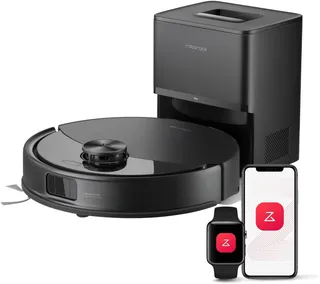
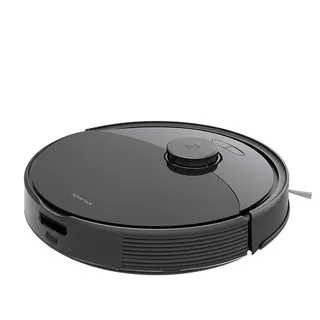
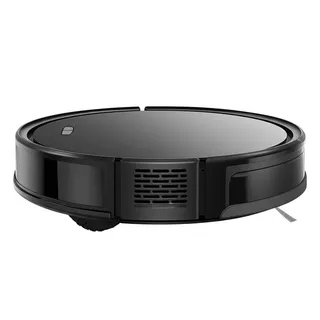
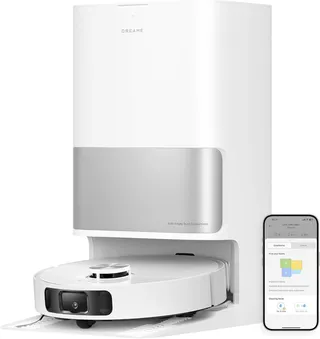
Roborock Q7 M5+
Released 2024
Suction
10,000 Pa
Battery
150 min
Navigation
Spinning Lidar
Mopping
1 Fixed Pad
Full Specifications
| Suction Power | 10,000 Pa |
| Battery Life | 150 min |
| Dustbin Capacity | 400 ml |
| Navigation | Spinning Lidar |
| Robot Height | 3.9" |
| Threshold Climbing | 20 mm |
| Brush Roll | Single |
| Mopping | 1 Fixed Pad |
| Self-Empty Dock | Bagged |
| Dock Bag Capacity | 2.7 L |
| Obstacle Avoidance | No |
| Multi-Floor Maps | Yes |
| No-Go Zones | Yes |
| Carpet Boost | Yes |
| HEPA Filter | Yes |
| WiFi | 2.4 GHz |
| Voice Assistants | Alexa |
| Warranty | 1 year |
Compare with similar models:
The Budget Robot Vacuum That Punches Above Its Weight
Wirecutter named the Roborock Q7 M5 Plus its “Top Pick” in November 2025, and for good reason: this robot delivers 10,000Pa of suction power at a price point where most competitors max out around 4,000Pa. That’s not marketing fluff either. Independent testing by Vacuum Wars clocked it at 2.24 kPa, ranking it 12th among over 150 robot vacuums tested.
But here’s what the marketing materials won’t tell you: the battery life is roughly half what’s advertised, the mopping is mediocre at best, and this thing will absolutely run over your charging cables. Let’s break down whether those trade-offs are worth it for your home.
Pricing and Availability
The Q7 M5 Plus launched in June 2024 with an MSRP of $359. That price bounces around considerably. Amazon has dropped it as low as $219 (a 39% discount), and Roborock’s own store regularly lists it at $259.99.
Two versions exist: the base Q7 M5 (vacuum and mop only) and the Plus model reviewed here, which includes the RockDock Plus auto-empty station. You can get it in Black or White.
Compared to its predecessor, the Q7 Max Plus, this model offers 2.4 times the suction power at a lower price. The catch? Roborock shrunk the battery from 5200mAh to 3200mAh.
Hardware: What Actually Matters
Suction and Cleaning
The 10,000Pa HyperForce suction is the real deal. Airflow comes in at 11 CFM, which is below the 16.4 CFM average for robot vacuums, but the suction efficiency compensates well enough for most debris types.
The robot uses a single rubber brush roll with an anti-tangle design (Roborock calls it “JawScrapers Comb”) and one side brush. There’s no dedicated carpet detection sensor. Instead, the robot feels when it’s on carpet by monitoring motor resistance, then automatically kicks up the suction.
The dustbin holds 400ml, which is respectable for this price range.
Navigation
PreciSense LiDAR navigation handles mapping duties via a top-mounted spinning laser. The robot builds 3D maps and can store up to four floor plans for multi-level homes.
What it cannot do: avoid obstacles. There’s no camera, no 3D structured light, nothing to help it see that phone charger on the floor or your kid’s LEGO creation. The robot will collide with objects and only realizes something’s in the way after bumping into it. Users report frequent run-ins with cables, pet toys, and yes, pet waste. Once it hits something, it just… keeps going over it.
The Battery Reality Check
Roborock advertises 150 minutes of runtime. Real-world users report 70-80 minutes on mixed power settings. That’s a significant gap.
Vacuum Wars testing measured 1.18 minutes per 1% battery discharge, estimating coverage around 1,060 square feet per charge. That actually beats the 1,015 square foot class average, despite the below-average battery efficiency. Efficient navigation makes up for the smaller battery, at least partially.
Charging takes roughly four hours.
Physical Specs
| Specification | Value |
|---|---|
| Dimensions | 12.8” x 12.8” x 3.9” |
| Weight | 8.3 lbs (3.75 kg) |
| Threshold Climbing | 2cm (0.79 inches) |
| Noise Range | 72-80 dB |
The 3.9-inch height means it’ll fit under most furniture, though barely. If your couch has less than 4 inches of clearance, this robot isn’t going there.
Filtration
A washable E11 HEPA filter comes standard. Clean it every two weeks, replace it every 6-12 months, and make sure you let it air dry for at least 24 hours after washing. Pet owners report faster clogging, so plan on more frequent maintenance if you’ve got a shedding cat or dog.
About That Noise
The robot itself runs at 72-80 dB depending on the power setting. Carpet cleaning on auto-boost gets noticeably louder. But the real noise issue is the auto-empty dock. Users consistently describe it as “jet engine” loud. If you’re scheduling overnight cleans, prepare for a rude awakening when the robot returns to base.
The Mopping System: Expect Less
Here’s where things get disappointing. The Q7 M5 Plus has an electronically controlled water tank (270ml capacity) with three flow levels you adjust through the app. Water pumps onto the mop pad, which drags along the floor without any vibration or pressure.
The Carpet Problem
This robot cannot lift its mop. If you have carpets, you need to manually designate them as “no-mop zones” in the app. Forget to do this, and the wet mop pad will happily soak your carpet.
Lab vs. Reality
Vacuum Wars testing showed impressive dried stain removal, scoring 158 against an average of 93. But that came at a cost: the robot used twice as much water as typical (2.0g versus 1.0g average), leaving wet residue on floors.
Real users are less impressed. Reports consistently mention subpar mopping, water tracking, and even leakage. The discrepancy makes sense. Without pressure or vibration, the mop pad just passively drags along. That works fine in controlled lab conditions but struggles with real-world grime.
| Mopping Specs | Details |
|---|---|
| Water Tank | 270ml (9 oz) |
| Mop Pads | 1 washable microfiber included |
| Mop Pressure | None (passive drag) |
| Mop Lift | 0mm (no automatic lift) |
| Vibration | No |
Software and App Experience
The Roborock app scores 4.8 stars on iOS and 4.6 on Google Play. It’s polished and intuitive, with solid mapping and easy zone creation.
What Works
- Room selection and zone cleaning
- Multi-level mapping (up to 4 floors)
- 3D map visualization
- No-go zones and virtual barriers
- Recharge and resume
- Scheduling with Do Not Disturb mode
- Child lock
What Doesn’t
WiFi connectivity is 2.4GHz only, so if your router broadcasts primarily on 5GHz, you’ll need to set up a 2.4GHz fallback. Multiple users report reconnection issues roughly every third use, and the app sometimes requires password re-entry after updates.
There’s no voice assistant integration despite Amazon Alexa and Google Home being listed as compatible elsewhere, no HomeKit or Matter support, and no obstacle photography or pet tracking features found in pricier Roborock models.
Setup takes 5-10 minutes once you’ve connected to WiFi. Full home mapping runs 30-60 minutes depending on your floor plan size.
The RockDock Plus Auto-Empty Station
Dock Specifications
The included dock uses 2.7L disposable sealed bags. Expect to replace bags every 7-9 weeks with typical use. Auto-empty triggers when cleaning finishes or when battery drops below 20%. You can tweak the frequency in the app with “Balanced” or “Frequent” options.
Running Costs
Dust bags run $1.50-$2.50 each from third-party sellers, or about $15 for a 12-pack of generics. Official Roborock bags cost more. You’ll also need replacement filters ($33 each) every 6-12 months.
Total annual maintenance runs $75-150 depending on how often you replace parts and whether you buy official or generic.
Dock Limitations
The water tank doesn’t refill from the dock. You have to physically detach the robot to top up the mopping water, which users find annoying. There’s no mop washing or drying capability either.
And about that auto-empty noise: users describe it as “jet engine” loud. One estimate puts it at 120+ dB. Don’t schedule cleans to finish at 2 AM unless you want to wake the household.
What’s in the Box
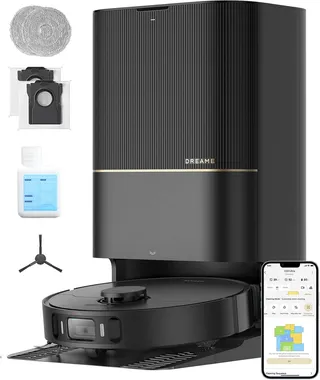
- Q7 M5 Plus robot
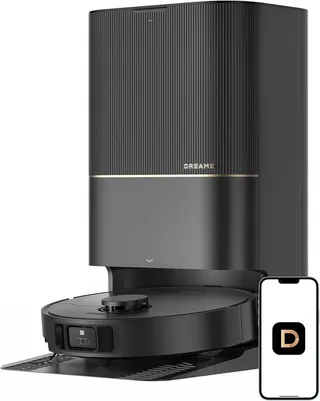
- RockDock Plus auto-empty dock
- 1 dust bag
- 1 washable mop pad
- 1 washable HEPA filter
- Moisture-proof mat with adhesive
- Power adapter and cords
- User manual
Cleaning Performance
By Debris Type
| Debris | Performance | Notes |
|---|---|---|
| Fine dust | 75% (average) | Struggles at edges and baseboards |
| Pet hair (2.5” strands) | 79% | Slightly below 81% average |
| Deep carpet sand | 75% | Matches class average |
| Large debris | Good | Reliable primary pickup |
| Crumbs | Good | Handles kitchen messes fine |
By Floor Type
The Q7 M5 Plus performs well on hard floors, though it tends to leave fine dust along baseboards. Tile cleaning is solid, with good grout line coverage. Hardwood works well generally, but expect gaps in corners and edges.
Low-pile carpet gets adequate cleaning, improving when carpet boost kicks in. Medium-pile carpet actually performs above average with carpet boost engaged. High-pile carpet is where things fall apart. Don’t rely on this robot for shag or thick plush carpets.
Navigation Efficiency
The robot moves at 0.84 square meters per minute, well above the 0.7 average. It cleans edges first, then fills in the middle. LiDAR mapping is reliable, though initial maps sometimes need manual correction when the robot misidentifies open spaces as separate rooms.
Pet Hair Reality
The anti-tangle brush handles pet hair adequately but not exceptionally. There’s no pet-specific cleaning mode. And without obstacle avoidance, the robot will spread pet accidents across your floor if it encounters them.
Who Should Buy This
The Q7 M5 Plus makes sense for:
- Homes with mostly hard floors where occasional mopping is a bonus, not a requirement
- Pet owners who want strong suction without AI complexity and are willing to prep their floors
- Budget-conscious buyers prioritizing value over cutting-edge features
- Multi-level homes benefiting from four-floor mapping
Who Should Skip It
Look elsewhere if you have:
- High-pile carpets where the smaller battery and marginal suction won’t cut it
- Lots of floor clutter since no obstacle avoidance means cables and toys will get run over
- Night-time cleaning needs given the deafening auto-empty dock
- Serious mopping requirements because the passive drag system won’t handle real stains
Known Issues and Gotchas
Users report several consistent problems:
- Water leakage where water pools in the dustbin despite a supposedly sealed tank
- Battery degradation with runtime dropping to 70-80 minutes within months
- Mop pad glitches where removing the pad manually disables mopping until you restart the app multiple times
- Filter clogging especially in homes with pets
- Hair tangling despite the “anti-tangle” design
Build quality feels lightweight compared to premium Roborock models. Expect a 2-3 year lifespan based on user reports.
Warranty and Support
Roborock provides a one-year limited warranty covering manufacturing defects, battery issues, and motor failures. Water damage, accidental damage, and unauthorized repairs aren’t covered.
Contact support at [email protected] (or [email protected] for EU buyers). Response time runs 24-48 hours. Phone support exists but with limited availability. Security updates are guaranteed through June 2026.
Third-party extended warranties through Asurion and similar providers cost $29-39 for 2-3 years of coverage.
The Bottom Line
The Roborock Q7 M5 Plus delivers exceptional suction power for its price. At $219-359, you’re getting 10,000Pa suction, reliable LiDAR mapping, and hands-off dust disposal for 7-9 weeks at a time.
The trade-offs are real though. That 150-minute battery claim translates to 70-80 minutes in practice. The mopping is passive and underwhelming. There’s zero obstacle avoidance, so you’ll need to clear your floors. And the auto-empty dock sounds like a jet taking off.
For hard-floor homes without too much clutter on the ground, it’s genuinely excellent value. For everyone else, you might want to look at models with obstacle avoidance or better mopping, even if that means spending more.